Buy rom-o-matic.eu ?
We are moving the project
rom-o-matic.eu .
Are you interested in purchasing the domain
rom-o-matic.eu ?
domain@kv-gmbh.de · 0541-91531010
Buy rom-o-matic.eu ?
When do I use 'o' or 'est-ce que'?
You can use both "o" and "est-ce que" to form questions in French. "O" is a more informal way to ask a yes/no question, while "est-ce que" is a more formal and structured way to form questions. "Est-ce que" is often used in written French or in formal situations, while "o" is commonly used in spoken French. **
What are the relative pronouns que, qui, qu', and o?
The relative pronouns que, qui, and qu' are used to introduce a subordinate clause that provides more information about a noun in the main clause. "Que" is used to refer to a direct object, "qui" is used to refer to the subject of the subordinate clause, and "qu'" is used before a vowel sound. "Où" is used to refer to a place or a time in the subordinate clause. These relative pronouns help to connect and provide more details about the noun in the main clause. **

Similar search terms for Que
Top-Angebote
Products related to Que:
-
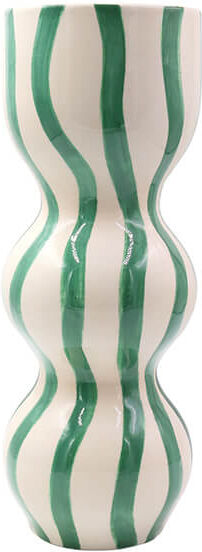
Que Rico Rayas Bailarinas Raquel VaseThis Que Rico Vase Raquel - Rayas Bailarinas is perfect for displaying beautiful fresh flowers or a more permanent dried flower arrangement. Inspired by Spanish lifestyle this colourful Rayas Bailarinas pattern adds a warm and inviting look to your home with the gentle green lines against the beautiful curves of the vase. Handmade and hand painted for a truly unique finish, this vase also makes the perfect gift with the gift packaging included. Dimensions: 34.5(H) x 14(W) x 14(L)cm.52,00 £*Shipping: 0,00 £Secure redirect to the provider
-
Que Rico Fuego Floral Rodrigo VaseThis Que Rico Vase Rodrigo - Fuego Floral is perfect for displaying beautiful fresh flowers or a more permanent dried flower arrangement. Inspired by Spanish lifestyle this Fuego Floral pattern features a combo of pink and orange in a fun wavy design with matching orange handles. Handmade and hand painted for a truly unique finish, this vase also makes the perfect gift with the gift packaging included. Dimensions: 24.5(H) x 13(W) x 21(L)cm.48,00 £*Shipping: 3,50 £Secure redirect to the provider
-
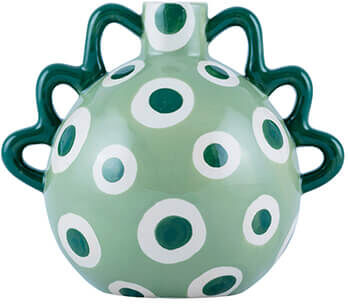
Que Rico Dancing Dots Isidora VaseThis Que Rico Vase Isidora - Dancing Dots is perfect for displaying beautiful fresh flowers or a more permanent dried flower arrangement. Inspired by Spanish lifestyle this Dancing Dots pattern features a colourful and bold design in green and white with a pair of wavy and stylish handles in green. Handmade and hand painted for a truly unique finish, this vase also makes the perfect gift with the gift packaging included. Dimensions: 16.5(H) x 15(W) x 20(L)cm.20,00 £*Shipping: 3,50 £Secure redirect to the provider
-
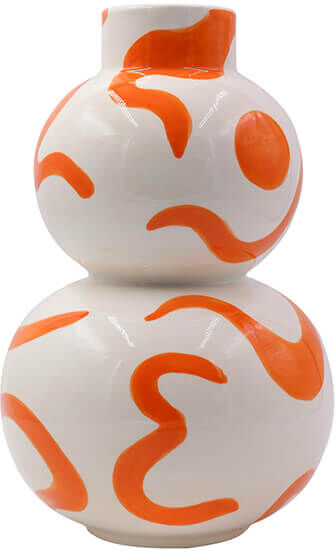
Que Rico Sol Y Sombra Isla VaseThis Que Rico Vase Isla - Sol Y Sombra is perfect for displaying beautiful fresh flowers or a more permanent dried flower arrangement. Inspired by Spanish lifestyle this colourful Sol Y Sambra pattern adds a ray of sunshine to your home. Handmade and hand painted for a truly unique finish, this vase also makes the perfect gift with the gift packaging included. Dimensions: 28(H) x 18(W) x 18(L)cm.50,40 £*Shipping: 0,00 £Secure redirect to the provider

-
What is the difference between "hay que" and "tener que"?
"Hay que" and "tener que" both express the idea of necessity, but they are used in slightly different contexts. "Hay que" is used to express a general obligation or necessity, often referring to a rule, law, or social norm. For example, "Hay que estudiar para tener buenas notas" (One must study to get good grades). On the other hand, "tener que" is used to express a specific obligation or necessity that is related to a particular person or situation. For example, "Tengo que terminar este informe antes de la reunión" (I have to finish this report before the meeting). **
-
What is the difference between autant que and aussi que?
The main difference between "autant que" and "aussi que" is their usage in comparisons. "Autant que" is used to express equality in comparisons, meaning "as much as" or "as many as." For example, "Il mange autant que moi" (He eats as much as I do). On the other hand, "aussi que" is used to express similarity in comparisons, meaning "as... as." For example, "Elle est aussi belle que sa mère" (She is as beautiful as her mother). Therefore, "autant que" is used for equality, while "aussi que" is used for similarity in comparisons. **
-
How do you know when to use "tener que" or "hay que"?
"Tener que" is used when referring to a specific person or group of people who have an obligation or necessity to do something. For example, "Tengo que estudiar" (I have to study). On the other hand, "Hay que" is used when talking about a general obligation or necessity that applies to everyone. For example, "Hay que respetar las reglas" (One must respect the rules). So, the choice between "tener que" and "hay que" depends on whether the obligation is specific to an individual or more general. **
-
When is the subjunctive used with pienso que and no pienso que?
The subjunctive is used with "pienso que" when there is doubt, uncertainty, or subjectivity in the statement that follows. For example, "No pienso que venga a la fiesta" (I don't think he is coming to the party). In this case, the subjunctive "venga" is used because there is doubt about whether he will come. However, when there is certainty or a fact stated after "pienso que," the indicative mood is used. For example, "Pienso que ella viene a la fiesta" (I think she is coming to the party). **


What is the difference in Spanish between "ojalá que" and "espero que"?
The main difference between "ojalá que" and "espero que" in Spanish is the level of certainty or hope expressed. "Ojalá que" is used to express a wish or hope for something to happen, but with a sense of uncertainty or doubt about whether it will actually happen. On the other hand, "espero que" is used to express a hope or expectation for something to happen, with a stronger sense of confidence or belief that it will actually occur. In summary, "ojalá que" conveys a more uncertain hope, while "espero que" conveys a more confident hope. **
What does "qu'est-ce que" and "est-ce que" mean in French?
"Qu'est-ce que" means "what" in French and is used to form a question. For example, "Qu'est-ce que tu fais?" means "What are you doing?" On the other hand, "est-ce que" is a way to form a yes/no question in French. For example, "Est-ce que tu viens?" means "Are you coming?" **
Top-Angebote
Products related to Que:
-
PDX Suck-O-Matic - cordless, automatic masturbator (black)It sucks and vibrates at the same time - a rechargeable masturbator that combines vibration with real suction.Why is the PDX Suck-O-Matic rechargeable masturbator so good?The Suck-O-Matic combines two effects in one device: alongside 7 vibration modes you can also choose from 7 suction programmes, and these can be controlled independently with separate buttons. The rigid shell provides a stable grip, while the soft, flexible inner TPE sleeve is removable, making it easy to clean and replace. The LED display shows which mode is currently active. It runs on a built-in rechargeable battery and can be charged via USB.Why customers like itVibration + suction in one unit: 7 + 7 modes, adjustable independently of each otherSeparate buttons (V and S): the two functions can run in parallel or be used separatelyRemovable inner sleeve: can easily be taken out of the hard shell, easy to cleanLED display: shows the current modeBuilt-in battery: 2.5 hours charging time, up to 70 minutes’ running timeStable, rigid casing: comfortable to hold, no need to squeezeWhat the package contains1 PDX Suck-O-Matic masturbator (black, transparent)1 removable soft TPE sleeve1 USB charging cableProduct featuresType: sucking and vibrating masturbatorTotal length: 26.5 cmInsertable length: 12.4 cmInternal diameter: 2 cmMaximum width: 8.8 cmVibration modes: 7Suction modes: 7Running time: up to 70 minutesCharging time: 2.5 hours (USB)Material: ABS shell, TPE sleeveColour: black, transparentWaterproof: noPhthalate-free: complies with EU Regulation 1907/2006/ECHow to useApply a water-based lubricant to the inner sleeve and the penis, then insert. Press and hold the V button for 3 seconds to start the vibration; further presses cycle through the 7 modes. Start the suction in the same way with the S button. The two functions can run simultaneously. To switch off, press and hold the relevant button.ChargingConnect the supplied USB cable to the charging socket on the back of the device. A full charge takes about 2.5 hours.Things to bear in mind during useNot waterproof: when cleaning, make sure no water reaches the electrical components - remove the inner sleeve and wash it separatelyUse water-based lubricant only: silicone- or oil-based lubricants will damage the TPE sleeveAfter use, remove and wash the sleeve with lukewarm water and mild soap; once dry, use TPE care powder to prevent it becoming stickyWhen storing, do not let it touch other sex toys: the TPE material may react with other materialsUser manual105,62 £*Shipping: 0,00 £Secure redirect to the provider
-
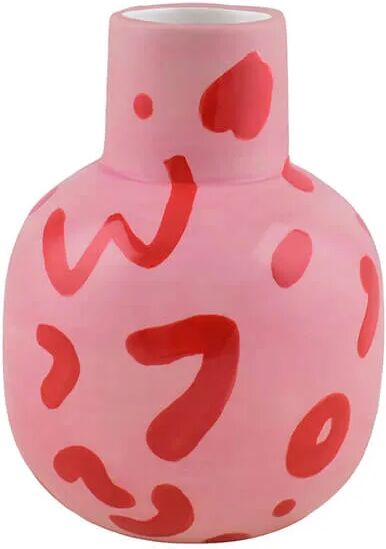
Que Rico Leopardo Lindo Rosita VaseThis Que Rico Vase Rosita - Leopardo Lindo is perfect for displaying beautiful fresh flowers or a more permanent dried flower arrangement. Inspired by Spanish lifestyle this colourful Leopardo Lindo pattern adds a pop of colour to your home with this vibrant red and pink combination. Handmade and hand painted for a truly unique finish, this vase also makes the perfect gift with the gift packaging included. Dimensions: 16(H) x 11.5(W) x 11.5(L)cm.17,60 £*Shipping: 3,50 £Secure redirect to the provider
-
Que Rico Rayas Bailarinas Raquel VaseThis Que Rico Vase Raquel - Rayas Bailarinas is perfect for displaying beautiful fresh flowers or a more permanent dried flower arrangement. Inspired by Spanish lifestyle this colourful Rayas Bailarinas pattern adds a warm and inviting look to your home with the gentle green lines against the beautiful curves of the vase. Handmade and hand painted for a truly unique finish, this vase also makes the perfect gift with the gift packaging included. Dimensions: 34.5(H) x 14(W) x 14(L)cm.52,00 £*Shipping: 0,00 £Secure redirect to the provider
-
Que Rico Fuego Floral Rodrigo VaseThis Que Rico Vase Rodrigo - Fuego Floral is perfect for displaying beautiful fresh flowers or a more permanent dried flower arrangement. Inspired by Spanish lifestyle this Fuego Floral pattern features a combo of pink and orange in a fun wavy design with matching orange handles. Handmade and hand painted for a truly unique finish, this vase also makes the perfect gift with the gift packaging included. Dimensions: 24.5(H) x 13(W) x 21(L)cm.48,00 £*Shipping: 3,50 £Secure redirect to the provider
-
When do I use 'o' or 'est-ce que'?
You can use both "o" and "est-ce que" to form questions in French. "O" is a more informal way to ask a yes/no question, while "est-ce que" is a more formal and structured way to form questions. "Est-ce que" is often used in written French or in formal situations, while "o" is commonly used in spoken French. **
-
What are the relative pronouns que, qui, qu', and o?
The relative pronouns que, qui, and qu' are used to introduce a subordinate clause that provides more information about a noun in the main clause. "Que" is used to refer to a direct object, "qui" is used to refer to the subject of the subordinate clause, and "qu'" is used before a vowel sound. "Où" is used to refer to a place or a time in the subordinate clause. These relative pronouns help to connect and provide more details about the noun in the main clause. **
-
What is the difference between "hay que" and "tener que"?
"Hay que" and "tener que" both express the idea of necessity, but they are used in slightly different contexts. "Hay que" is used to express a general obligation or necessity, often referring to a rule, law, or social norm. For example, "Hay que estudiar para tener buenas notas" (One must study to get good grades). On the other hand, "tener que" is used to express a specific obligation or necessity that is related to a particular person or situation. For example, "Tengo que terminar este informe antes de la reunión" (I have to finish this report before the meeting). **
-
What is the difference between autant que and aussi que?
The main difference between "autant que" and "aussi que" is their usage in comparisons. "Autant que" is used to express equality in comparisons, meaning "as much as" or "as many as." For example, "Il mange autant que moi" (He eats as much as I do). On the other hand, "aussi que" is used to express similarity in comparisons, meaning "as... as." For example, "Elle est aussi belle que sa mère" (She is as beautiful as her mother). Therefore, "autant que" is used for equality, while "aussi que" is used for similarity in comparisons. **
Similar search terms for Que
-
Que Rico Dancing Dots Isidora VaseThis Que Rico Vase Isidora - Dancing Dots is perfect for displaying beautiful fresh flowers or a more permanent dried flower arrangement. Inspired by Spanish lifestyle this Dancing Dots pattern features a colourful and bold design in green and white with a pair of wavy and stylish handles in green. Handmade and hand painted for a truly unique finish, this vase also makes the perfect gift with the gift packaging included. Dimensions: 16.5(H) x 15(W) x 20(L)cm.20,00 £*Shipping: 3,50 £Secure redirect to the provider
-
Que Rico Sol Y Sombra Isla VaseThis Que Rico Vase Isla - Sol Y Sombra is perfect for displaying beautiful fresh flowers or a more permanent dried flower arrangement. Inspired by Spanish lifestyle this colourful Sol Y Sambra pattern adds a ray of sunshine to your home. Handmade and hand painted for a truly unique finish, this vase also makes the perfect gift with the gift packaging included. Dimensions: 28(H) x 18(W) x 18(L)cm.50,40 £*Shipping: 0,00 £Secure redirect to the provider
-
Que Rico Rayas Bailarinas Yellow Elisa VaseThis Que Rico Vase Elisa - Rayas Bailarinas is perfect for displaying beautiful fresh flowers or a more permanent dried flower arrangement. Inspired by Spanish lifestyle this Rayas Bailarinas pattern features strong yellow stripes with a combo of multicoloured fun handles. Handmade and hand painted for a truly unique finish, this vase also makes the perfect gift with the gift packaging included. Dimensions: 27(H) x 13.5(W) x 24.5(L)cm.35,00 £*Shipping: 3,50 £Secure redirect to the provider
-
PDX Elite Fuck-O-Matic Pro XL automatic sucking masturbator - blackThe Pipedream PDX Elite Fuck-O-Matic Pro XL is a premium automatic male masturbator from the Pipedream X-Treme Elite range: Intermittent Suction Technology (IST) with intermittent suction that simulates the thrust itself. 5 vibration + 5 suction modes, lifelike Fanta Flesh interior, dual‑texture ball‑stimulation pad, LED display and USB‑rechargeable battery.What is the PDX Elite Fuck-O-Matic Pro XL?The Pipedream PDX Elite range is the premium segment of male masturbators (Pipedream has been one of the industry leaders since 1973). The Fuck-O-Matic Pro XL is more than 50% larger than the “Original” model - hence the XL name. Its special feature is the Intermittent Suction Technology (IST): not continuous suction but rhythmic, intermittent suction that simulates the thrust of an active partner - “strokes for you”, i.e. it does the work for you. This is complemented by 5 vibration modes and the dual‑texture ball stimulator on the red TPE pad.Why do customers like the PDX Elite Fuck-O-Matic Pro XL?Intermittent Suction Technology (IST) - intermittent suction that simulates thrust; this is Pipedream’s signature technologyUltra Suction - powerful vacuum effect5 vibration + 5 suction modes - 25 possible combinations for complete personalisationDual‑texture ball‑stimulation pad - two different nub patterns (dotted + denser textured) on the red silicone surface provide targeted stimulation for the ballsFanta Flesh® lifelike skin sleeve - Pipedream’s signature internal material with a realistic skin‑like feelelite Silicone™ - premium, body‑safe silicone gradeLED display - the selected mode is easy to readSeparate V (Vibration) and S (Suction) buttons - simple, intuitive controlXL size - 50% larger than the original Fuck-O-Matic, making it suitable for larger penis sizes as wellUSB‑rechargeable battery - with included charging cableStrong, ergonomic ABS housing - stable grip, secure controlWho do we recommend it for?Experienced users who want a premium‑level automatic male masturbatorThose looking for the full “active partner experience” - not just a passive sleeve, but active “stroking” actionUsers with a larger penis size (XL internal diameter, min. 5.1 cm, flexible)Those who value combinable functions (vibration + suction also usable independently)Those for whom ball stimulation adds an extra dimensionHow to useFully charge the device with the supplied USB cable.Apply a generous amount of water‑based lubricant to your penis and to the inside of the Fanta Flesh sleeve.Insert the penis; your balls should rest on the red TPE pad.Switch on with the Power button - check the LED display.Activate vibration with the V button (you can switch between 5 modes).Activate IST suction with the S button (5 intermittent suction modes).Combine the two functions - experiment to find which combination works best for you.As you approach climax, switch to higher intensity.ControlsPower button (centre): on / offV button (Vibration): cycles through 5 vibration modesS button...187,00 £*Shipping: 0,00 £Secure redirect to the provider
-
How do you know when to use "tener que" or "hay que"?
"Tener que" is used when referring to a specific person or group of people who have an obligation or necessity to do something. For example, "Tengo que estudiar" (I have to study). On the other hand, "Hay que" is used when talking about a general obligation or necessity that applies to everyone. For example, "Hay que respetar las reglas" (One must respect the rules). So, the choice between "tener que" and "hay que" depends on whether the obligation is specific to an individual or more general. **
-
When is the subjunctive used with pienso que and no pienso que?
The subjunctive is used with "pienso que" when there is doubt, uncertainty, or subjectivity in the statement that follows. For example, "No pienso que venga a la fiesta" (I don't think he is coming to the party). In this case, the subjunctive "venga" is used because there is doubt about whether he will come. However, when there is certainty or a fact stated after "pienso que," the indicative mood is used. For example, "Pienso que ella viene a la fiesta" (I think she is coming to the party). **
-
What is the difference in Spanish between "ojalá que" and "espero que"?
The main difference between "ojalá que" and "espero que" in Spanish is the level of certainty or hope expressed. "Ojalá que" is used to express a wish or hope for something to happen, but with a sense of uncertainty or doubt about whether it will actually happen. On the other hand, "espero que" is used to express a hope or expectation for something to happen, with a stronger sense of confidence or belief that it will actually occur. In summary, "ojalá que" conveys a more uncertain hope, while "espero que" conveys a more confident hope. **
-
What does "qu'est-ce que" and "est-ce que" mean in French?
"Qu'est-ce que" means "what" in French and is used to form a question. For example, "Qu'est-ce que tu fais?" means "What are you doing?" On the other hand, "est-ce que" is a way to form a yes/no question in French. For example, "Est-ce que tu viens?" means "Are you coming?" **
* All prices are inclusive of VAT and, if applicable, plus shipping costs. The offer information is based on the details provided by the respective shop and is updated through automated processes. Real-time updates do not occur, so deviations can occur in individual cases. ** Note: Parts of this content were created by AI.